 Black Mouth Cur
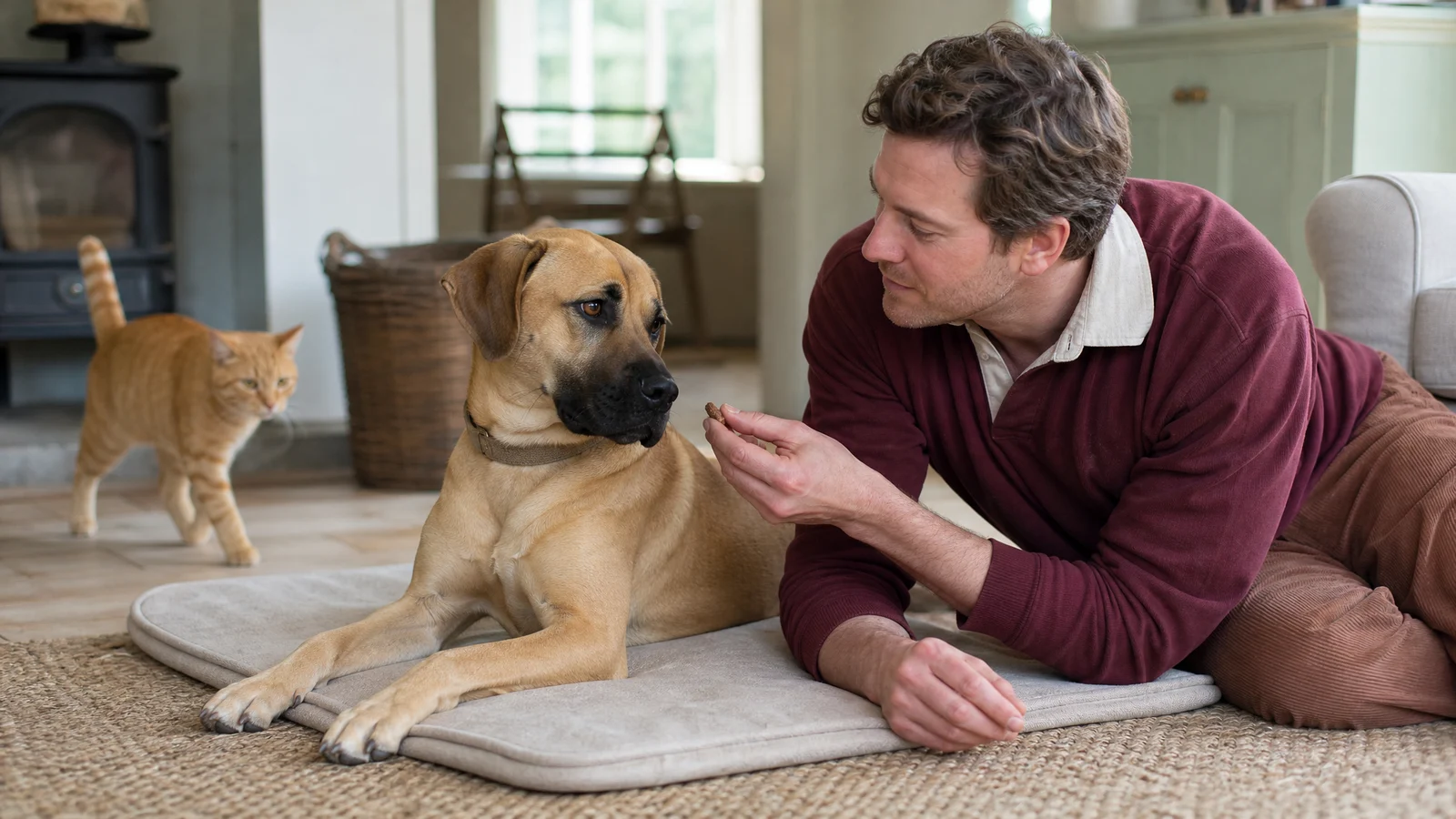
Some Black Mouth Curs watch the family cat stroll across the living room, give a glance, and go back to their chew. Others lock onto every flick of a tail, going still and silent in a way that makes you hold your breath. The difference rarely comes from one dog being good and the other bad. It comes from how the dog is built and how they have been handled.
That matters because a fixated dog who is allowed to rehearse staring and chasing gets better at it, and the cat ends up living on high alert. A dog who learns that the cat is simply part of the furniture gives you a home where everyone can relax.
This guide covers training around cats, from the instincts behind your Cur's stare to gated introductions, rewarded looks away, and the habits that keep chase out of your home for good.
How a Black Mouth Cur Hunts by Movement
To understand your dog around a cat, start with the job they were built for. The breed standard describes the Black Mouth Cur as a fast, hard hunter who finds game using their eyes, ears and nose. Those senses work as a team, and movement is the thing that ties them together: a rustle, a flicker at the edge of vision, a scent that suddenly gets fresher.
The same description says the breed combines tenacity and courage with a strong desire to work. Tenacity is the word to hold onto here, because a dog bred to stay with a task will not drop it just because the timing is inconvenient for you.
The standard also prefers silent trailers, so don't wait for barking to warn you. A Cur who is fixated on a cat is often quiet, still and intent.
None of this means your dog is a danger in a home with cats. It means the instinct is real, it was selected for over generations, and it responds to motion rather than to anything the cat has actually done. Once you see it that way, you can plan around it calmly instead of taking it personally.
Why Cats Trigger Fixation, and Where Training Starts
Cats are close to a perfect trigger for a dog built like this. They move in sudden bursts, freeze, crouch, dart under furniture and flick their tails, and each of those is the kind of motion a working dog is tuned to notice. The cat doesn't have to do anything wrong to set it off.
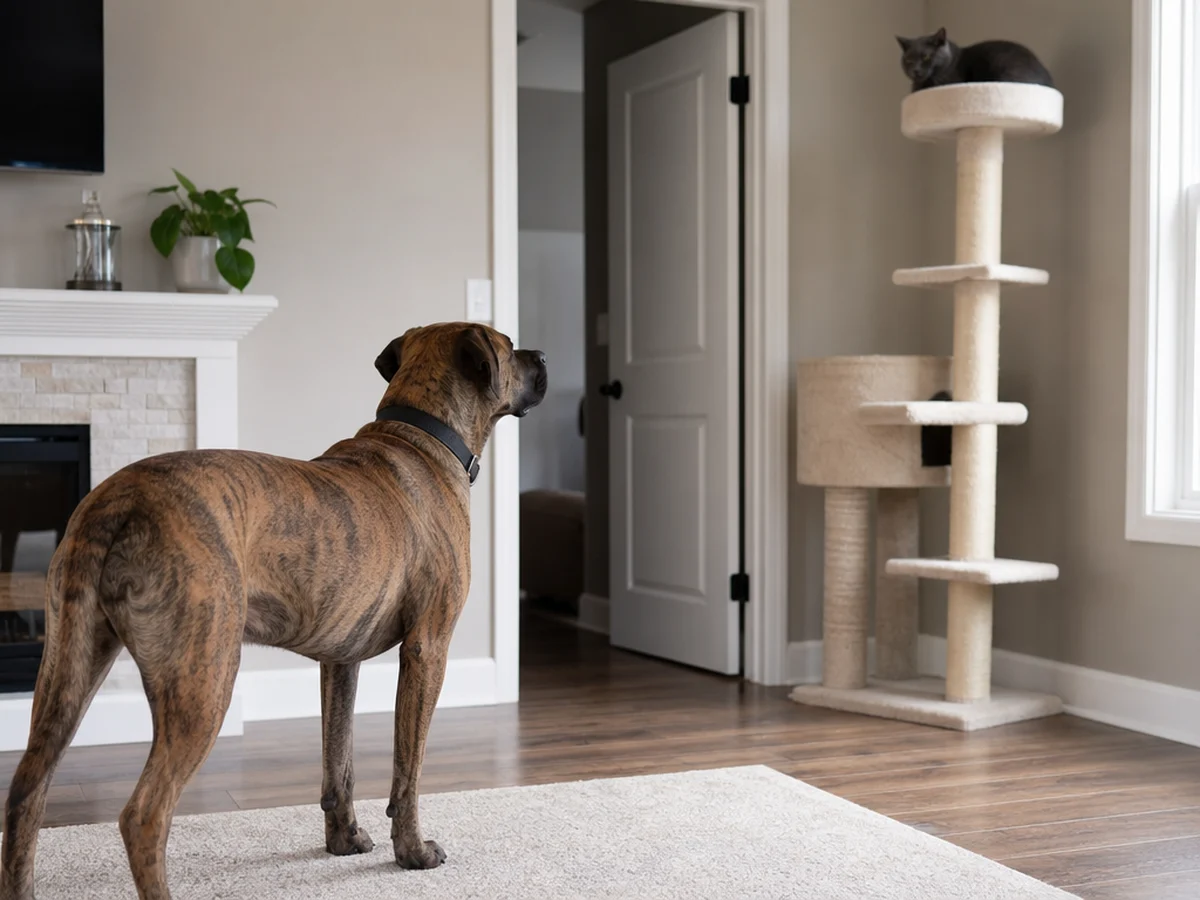
A stare can grow in steps. It often begins with a look, then a hard stare, then stillness, then a lowered body or a slow creep, and finally a burst forward if the cat runs. Every step you let slide makes the next one easier for your dog.
Running cats make it worse. A cat who bolts confirms everything your dog's instincts suspected, and the chase itself is rewarding to a dog like this.
That is why training starts early in the chain. Your best chance is the look, before the stare, because a dog who is still thinking can still choose. Watch your dog's eyes, ears and body the moment the cat appears, and treat the earliest signs of locking on as your cue to act.
Can Training Teach a Black Mouth Cur to Ignore Cats?
Often, yes, though "ignore" is a bigger word than training can always promise. Training changes what your dog chooses to do and how quickly they settle. It doesn't remove the instincts the breed was shaped around, and dogs vary a great deal in how strong those instincts are.
Reward-based training is the right approach here, for practical reasons as well as kind ones. Animal behavior specialists recommend only reward-based methods across dog training, and a dog who gets paid for a decision makes that choice more likely again. For a dog with this much drive, you want the right choice to be the one that pays.
Realistic goals look like this: a dog who notices the cat and looks away on their own, who settles in the same room, and who can be called off before locking on. Some dogs go further than that, and some will always need a gate or a leash when the cat is loose.
Plan for the dog you actually have rather than the one you hoped for. Your goal is a household that is safe and calm, not a dog with no instincts.
Training Gated Cat Introductions Step by Step
Gated introductions let both animals see and smell each other with no chance of a chase. Set up a baby gate or a screened doorway between your dog's space and the cat's, and make sure the cat has a high perch or a room they can reach that your dog cannot. Go slowly, because speed is what usually spoils these introductions.
First Sight Through the Gate
Start with your dog on a leash on one side of the gate, treats in your pocket, and the cat relaxed on the other side, ideally eating or lounging. Let your dog see the cat from a distance where they can still look away, and drop a treat each time they glance over and then turn back to you. If your dog stares, stiffens or stops taking food, you are too close, so add distance or end the session.
End each session early, before your dog tires of the exercise and while they are still calm and curious. A short session that finishes well is a success, not a failure.
Scent Swaps Before Meeting
Your dog reads the world through their nose, and this breed finds game with eyes, ears and nose together, so scent is a strong way to make the cat familiar. Rub a clean cloth on the cat's cheeks and bedding, let your dog sniff it while you hand out treats, and do the same in reverse with a cloth from your dog's bed.
Swap bedding too, so each animal meets the other's smell in a relaxed setting. Paired with good things, the cat's scent becomes a cue for calm rather than excitement.
Short Shared Sessions
Once your dog can see the cat through the gate and happily keep eating or checking in with you. Then try brief sessions in the same room.
Keep your dog on a leash, let the cat come and go freely, and reward calm behavior generously. The cat must always have a way out and never be cornered.
Make the exercise harder by changing the distance, the cat's movement or the length of the session, but never all together. If your dog's body goes rigid, go back a step without any fuss and rebuild from there.
How Do You Reward a Calm Look Away in Training?
A calm look away is the most useful skill in this whole article, because it is the opposite of fixation. You teach it by marking the exact moment your dog's eyes leave the cat with a marker word such as "yes," then paying with a treat. Deliver the treat down by your hip so your dog has to turn away from the cat to collect it.
Begin with something easy, like the cat sleeping on the far side of a gate, before you try a moving cat. Because this breed works by sight, motion and scent, a still cat is the beginner level and a walking or running cat is the advanced one.
Over time your dog starts offering the look away on their own. They glance at the cat and then checking in with you for payment.
Use rewards your dog truly loves, and mix them up. A high-value treat suits a close cat, while praise or a game of tug is best saved for after the cat has left the room, since exciting play can wind a working dog up instead of calming them. If your dog gets too stirred up to take food at all, the distance is too short and the session is over for now.
Keeping Chase Out of Black Mouth Cur Training
Every time your dog chases the cat, the habit gets stronger, and the chase pays for itself. So the most protective training you can do is prevent practice.
Management is not a sign that training has failed. It is half of the training, and it protects the cat while your dog is still learning.
Use a leash or a drag line whenever the two share space during the learning period, and use gates, closed doors or a crate when you can't supervise. The cat needs a say in this too, and these setups give them one:
- Give the cat high perches, shelves or a tall cat tree your dog cannot reach, so the cat can watch from above and never needs to run.
- Keep the cat's litter box and food somewhere your dog can't get to, such as behind a gate with a gap only the cat can use.
- Pick a gate over a closed door when you separate them, so both can see and smell each other without contact.
- Feed the animals in separate spaces, and read our guide to building trust around the bowl if mealtimes make your dog tense.
- Keep narrow hallways and doorways clear when both are loose, because a cat who feels trapped is the one most likely to dash.
If your dog starts to lock on anyway, say their name calmly, step between the two, and lure your dog away with a treat. If they are too wound up to eat, a calm time to settle in the crate or another room works better than any scolding. Then restart from an easier distance.
Cats and a Black Mouth Cur Years Later
Months in, a settled household looks pretty boring, and that is exactly the goal. The cat walks across the room and your dog glances over, then checks in with you or goes back to their bone. The cat eats where they like, sleeps on the sofa, and nobody tenses up.
Some safeguards stay in place. Gates remain around the cat's food and litter box, the cat keeps high routes, and you keep a few treats handy for new triggers such as a kitten, a visiting cat or a cat who suddenly bolts after a scare. Guests and kids bring their own challenges, so our guides to socializing a Black Mouth Cur with kids, dogs and strangers and to relaxing around visitors fit well alongside this work.
Plan to refresh your training after any big change, like a move, a new pet, or an older cat who slows down. Regular vet visits help here too, since changes in health, hearing or vision can shift how your dog and cat react to each other.
Calm around the cat is maintained, not finished. The breed's tenacity, sharp senses and drive to work don't retire, and that is also what makes them such attentive, loyal companions.
If you keep rewarding good choices and keep the gates, perches and leash habits quietly in the background for life, your Black Mouth Cur and your cat can share a home that feels easy to everyone in it.
 Training basicsSmart and Strong-Willed: Impulse Control and Focus Games
 BehaviorProtective but Polite: Teaching Your Cur to Relax Around Visitors
 BehaviorFence Jumping in Black Mouth Curs: Secure Yards and Better Outlets