 Black Mouth Cur
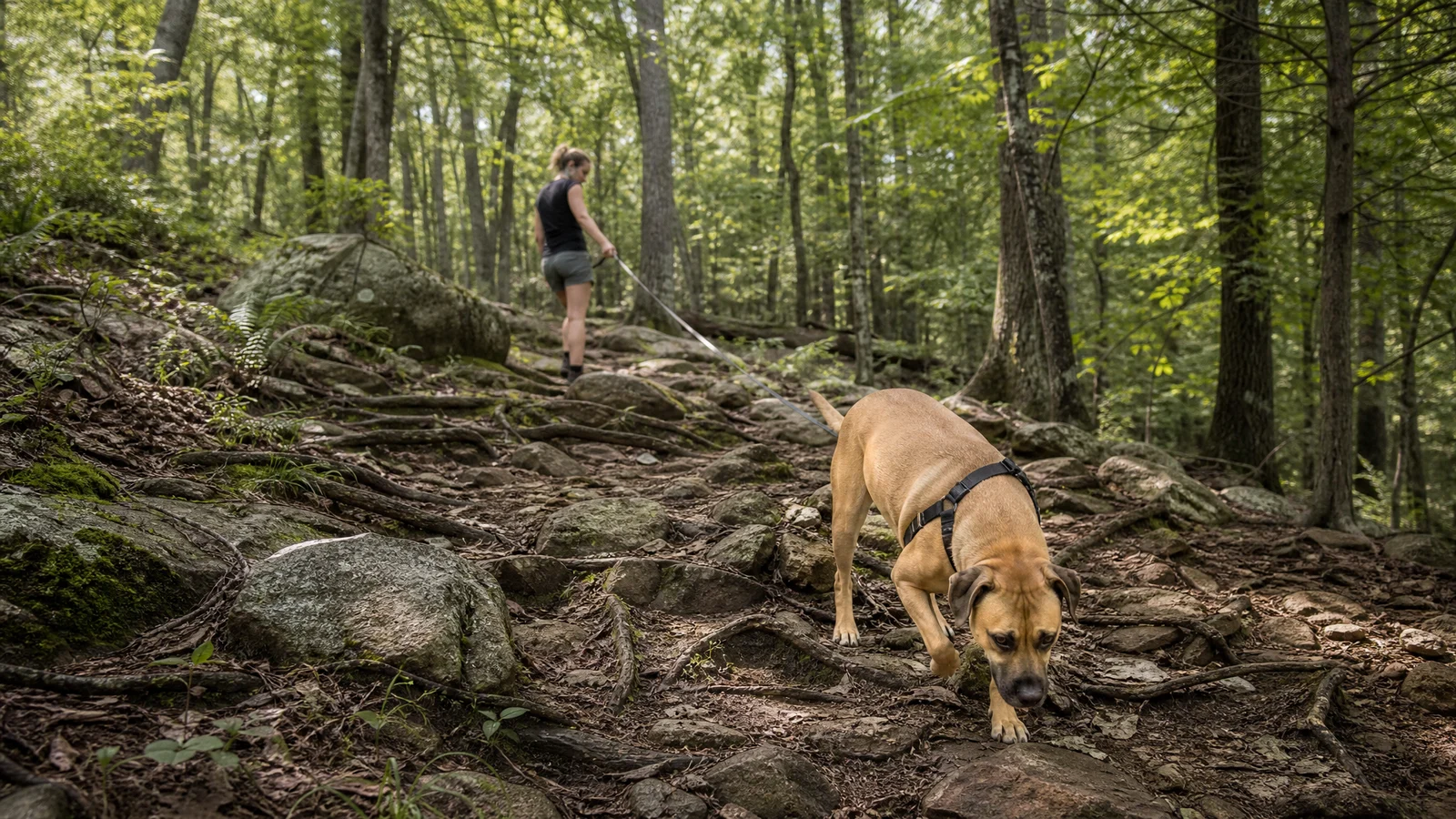
The common exercise mistake with a Black Mouth Cur is counting minutes and ignoring what happens inside them. A long outing on the same flat route can leave a working dog physically active yet mentally unoccupied, while a harder route without recovery can leave them too wound up to settle.
There is no sourced, breed-specific daily duration that fits every age and household. The breed standard instead gives us useful criteria: stamina, agility, muscular condition and a strong desire to work. Those traits point toward varied, purposeful activity rather than one universal mileage target.
Below, you'll find a five-part suitability scorecard covering terrain, purposeful movement, thinking, recovery and household fit. We will use those criteria to shape exercise and brain games without pretending that one number can describe every Black Mouth Cur.
Exercise Is More Than a Clock
The breed standard describes a powerful, agile working dog bred for stamina and expected in hard, muscular condition. That description supports a substantial need for activity, but it does not turn the dog into an endurance machine whose only requirement is more distance.
For broad context, PDSA says daily exercise needs can begin around an hour for some breeds, rise to twice that, and run significantly higher for working breeds. Treat the range as context rather than a fixed rule. Age, health, weather, conditioning and content still decide what fits. We take a clear position: adding miles is a poor first response to restlessness.
It can improve fitness without teaching the dog how to think, cooperate or come down afterward. A better plan gives movement a purpose and treats calm recovery as part of the work. Puppies and dogs returning from inactivity need a different load from conditioned adults.
Protect a growing body from repetitive impact, increase difficulty gradually, and keep regular veterinary visits on the calendar so exercise matches the individual dog rather than the reputation of the breed.
Black Mouth Cur Exercise Terrain and Purpose
The first two criteria describe the movement itself. Terrain asks what the body must negotiate, while purpose asks whether the dog has a reason to attend to you. A plan can score well on one and poorly on the other, which is why a varied walk is not automatically a complete one.
Terrain Changes the Exercise
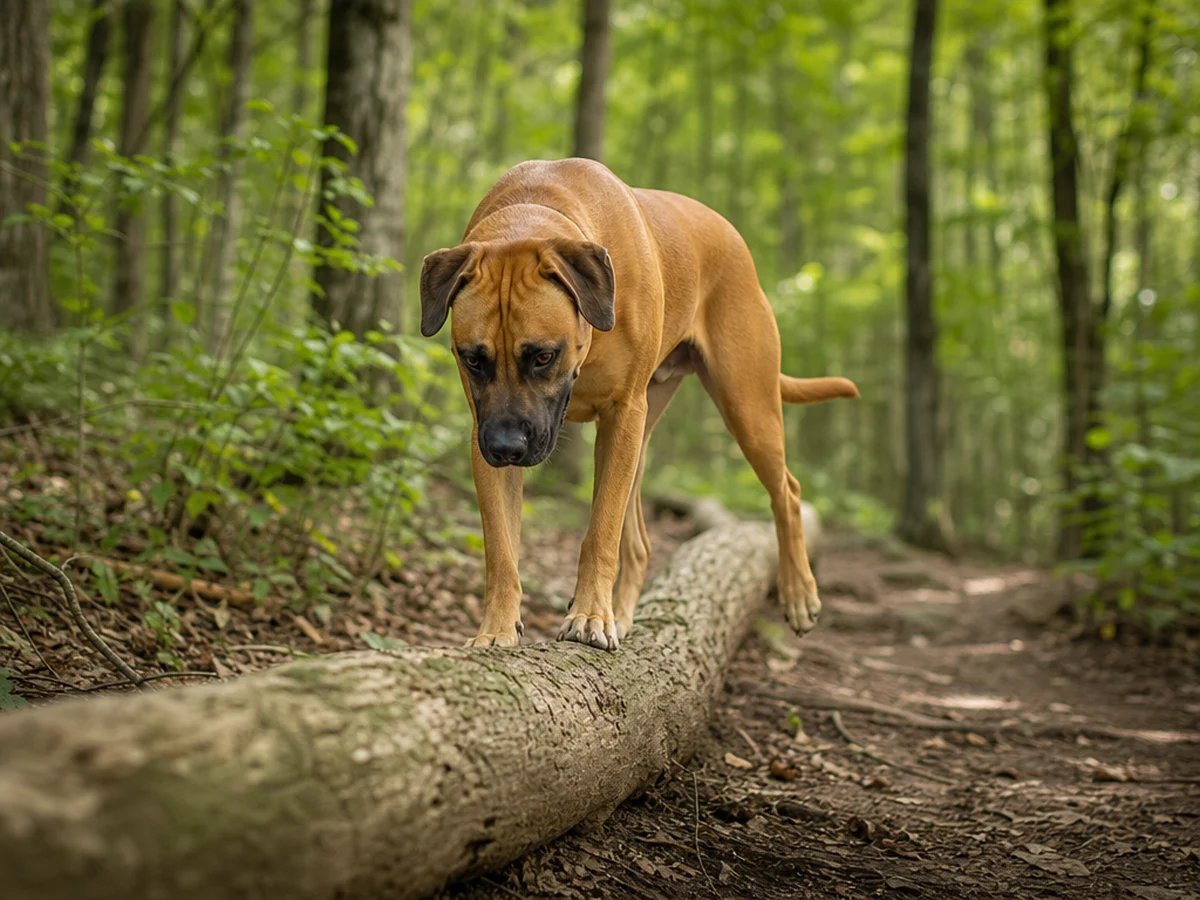
Flat sidewalk, soft grass, gentle slopes and stable natural surfaces ask different questions of balance and pace. Variety can build body awareness without turning every outing into hard exertion. Choose footing you can see clearly, especially when the dog is young, tired or new to the route. Terrain should create thoughtful movement, not risk.
Step over a low natural obstacle, pause before a change in surface, or walk a broad curve on a mild slope. Those choices suit an agile dog while keeping you in control of speed and difficulty.
Purposeful Movement Has a Job
Purposeful movement asks the Cur to do something with you: check in before crossing, follow a change of direction, carry a toy across the yard, or move between two marked places. The task is ordinary, but it gives a tenacious dog a clear start and finish. Use rewards to keep that purpose cooperative.
The reward-based framework includes structure, routine and guidelines, so a planned route can be both enjoyable and orderly. Reward a check-in, release the dog to sniff, then resume together. Purpose also keeps exercise from becoming a constant race. If every outing rewards only speed, the dog practices moving away from you. If parts of the route reward attention, changes of pace and permission to investigate, physical activity also strengthens partnership.
Exercise Thinking and Recovery
The next pair looks beyond the legs. Thinking gives the desire to work somewhere useful to go, and recovery shows whether the whole plan leaves the dog able to rest. A Cur who finishes exercise frantic, mouthy or unable to disengage may need a different balance rather than a larger load. Brain games should involve a problem the dog can solve, not frustration they cannot escape.
Thinking Turns Energy Into Work
Easy scent searches are a strong starting point because the nose guides the work and success is built in. Best Friends suggests beginning nose work by baiting open boxes so finding food rewards the search. You can also hide a familiar toy in an easy place, scatter food in safe grass, or teach the dog to put an object in a basket. Raise one difficulty at a time.
A search can become longer, the hiding place can become less obvious, or the room can change, but avoid making every part harder at once. Thinking belongs inside physical activity too. Ask for a hand target before opening the gate, a brief wait before releasing to sniff, or a return to your side after investigating. These small jobs make the exercise plan feel coherent to a dog bred with a strong desire to work.
Recovery Completes the Session
Recovery is not merely the absence of exercise. It is the transition from effort to ordinary household calm. End hard play with slower sniffing, offer water, reduce stimulation and reward relaxed behavior on a mat rather than launching directly into another exciting event. Judge recovery by what follows.
The dog should move comfortably, eat and drink normally, and become able to rest. Lingering agitation, reluctance to move, or a change in gait means the plan needs to be reduced and discussed with your veterinarian when appropriate.
Black Mouth Cur Exercise at Home
An exercise plan succeeds only if the household can repeat it safely. A rural route, a city block and a fenced yard offer different opportunities, but none automatically meets a Cur's needs. Household fit measures whether the people, spaces and schedule support purposeful activity and a reliable recovery period. Start with what the home can deliver consistently.
Household Fit Makes Exercise Repeatable
An apartment household might use several shorter outings, indoor searches and stair-free body-awareness games. A home with a yard still needs interaction, because releasing a dog outside does not give the movement a purpose or teach cooperation. Match activities to the people as well.
Children can toss food for a supervised find game, while an adult controls gates, routes and higher-energy play. If the household cannot maintain a complex plan, simplify it to a few dependable pieces rather than creating an ambitious schedule that disappears after several days. Household fit includes coexistence with other dogs.
Shared play can be useful only when both dogs remain willing participants, so build breaks and separate rest areas into the plan. Solo activity matters because it teaches the Cur to work with you rather than depending on another dog for every outlet. Connect the plan to broader skills.
Focus and settling make purposeful activity easier to manage, while Black Mouth Cur sports and jobs can add structured options once foundations and physical readiness are in place.
Build a Black Mouth Cur Exercise Mix
A useful day does not need five separate events, one for each score. One thoughtful outing can cover terrain, purpose and thinking, followed by deliberate recovery at home. The goal is to combine criteria without making every minute a lesson. Choose from these components according to the dog's age, condition and environment.
Each component should have a clear role in the finished exercise mix. Together, the choices should cover useful movement, shared attention and a calm finish without forcing every criterion into a separate session:
- Use a varied walk with safe footing, changes of pace and generous sniffing rather than treating the route as a speed test.
- Add one small job, such as finding a toy, returning to a marked place or carrying an appropriate object to you.
- Practice a few rewarded check-ins around mild distractions so attention becomes part of movement.
- Finish with slower activity and a familiar settle routine, then observe how comfortably the dog recovers.
- Keep an easier option ready for hot weather, a busy day or a dog who shows less enthusiasm than usual.
Change the mix before increasing the total load. A repetitive route may improve when you add sniffing and check-ins, while a frantic play session may improve when you shorten the fast portion and lengthen the calm finish. Quality is a more useful adjustment lever than automatic escalation.
Keep an easy version of every favorite activity. A shorter search with obvious hiding places, a familiar loop with more sniff stops or slow toy carries across the yard can preserve the job on a lower-load day. The dog still gets a beginning and an outcome without every session becoming a test of endurance. Weather and health can change the score overnight.
On an unsuitable day, move thinking work indoors and lower the physical demand. Regular veterinary care helps you revise the plan as the dog grows, ages or returns from an interruption.
Recheck the Exercise Scorecard
Use the scorecard on an ordinary day, not the household's best weekend adventure. A weak score is not a judgment on the dog or owner. It identifies the one part of the plan most likely to produce a useful improvement. Observe the next morning as well as the moment an activity ends.
Comfortable movement, ordinary enthusiasm and the ability to settle suggest the load was manageable. A dog who is reluctant, unusually restless or less coordinated needs an easier plan, not a challenge designed to push through the change.
| Criterion | A Strong Score Looks Like | A Reason to Adjust |
|---|---|---|
| Terrain | Safe, visible and varied enough for thoughtful movement | Only repetitive footing or difficulty beyond conditioning |
| Purposeful movement | The dog checks in and completes simple shared jobs | Every activity rewards speed or independent roaming |
| Thinking | Problems are solvable and success stays frequent | The dog guesses frantically or quits in frustration |
| Recovery | Effort gives way to comfortable rest | Agitation or physical discomfort persists afterward |
| Household fit | The plan is safe and repeatable in real life | It depends on space, time or help you rarely have |
Rescore after changing the weakest criterion while keeping the others steady. If terrain is repetitive, vary the surface before adding distance. If thinking is absent, place a simple search inside the existing walk. If recovery is poor, reduce intensity and make the finish quieter. The best Black Mouth Cur exercise plan is not the one with the largest number.
It is the one that keeps a powerful, agile dog moving with purpose, solving manageable problems and returning home able to rest. Build that balance first, then let the individual dog's response guide the next adjustment.
 Training basicsHow to Potty Train a Black Mouth Cur Puppy
 Training basicsHow to Train a Black Mouth Cur Without Fighting Their Drive
 Training basicsLeash Training a Black Mouth Cur Who Pulls or Lunges