 Black Mouth Cur
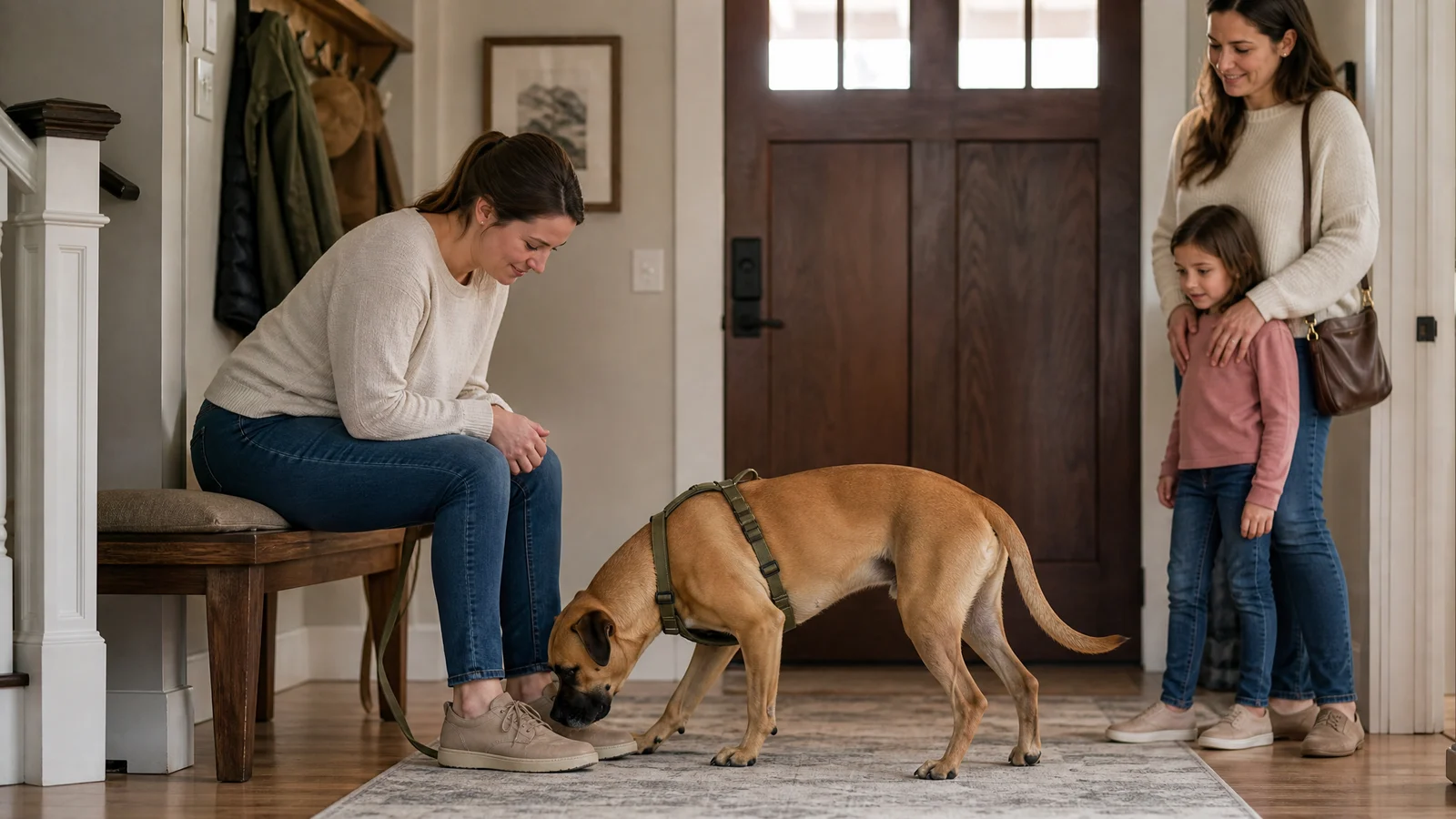
The door opens, a child moves forward and a visitor reaches toward the Black Mouth Cur at the same time. That possible household moment contains too much social pressure for useful learning. Socialization works better when the people control space and let the dog observe before contact.
The breed standard describes loyalty and protectiveness toward owner and family, while viciousness and extreme shyness are disqualifying. That does not predict one dog's behavior with children, dogs or strangers. It does explain why calm, well-paced introductions deserve more thought than a goal of meeting everyone.
Read on for a zoomed view of socializing, from household boundaries to children, visitors, neighborhood strangers, other dogs and public space. We finish close to the dog, where posture, movement and recovery show whether an experience is helping.
Socializing Starts With Household Boundaries
Begin with the home because every later introduction depends on what happens there. Decide where the dog can retreat, which doors and gates adults control, and how people respond when the Cur chooses distance. A safe boundary keeps loyalty from becoming a job the dog must manage alone. Give the dog a resting area that visitors and children never enter. Reward them for going there before the household becomes busy, and provide a calm activity when appropriate.
A retreat is not isolation. It is a predictable choice that prevents contact from becoming compulsory. Use a household-wide rule: the dog approaches people, rather than people surrounding the dog. That rule works for an outgoing Cur as well as a cautious one because it reduces grabbing, leaning and head-on pressure. It also gives adults time to notice whether the dog's body remains loose.
Black Mouth Cur Socializing With Kids
Children need training before they interact with the dog. Their fast movement, noise and unpredictable touch can raise arousal even in a friendly puppy. The ASPCA notes that playful mouthing is normal in puppies and young dogs, which makes adult supervision essential rather than optional. Use these boundaries whenever children and a Cur share space. The rules protect both sides before excitement builds:
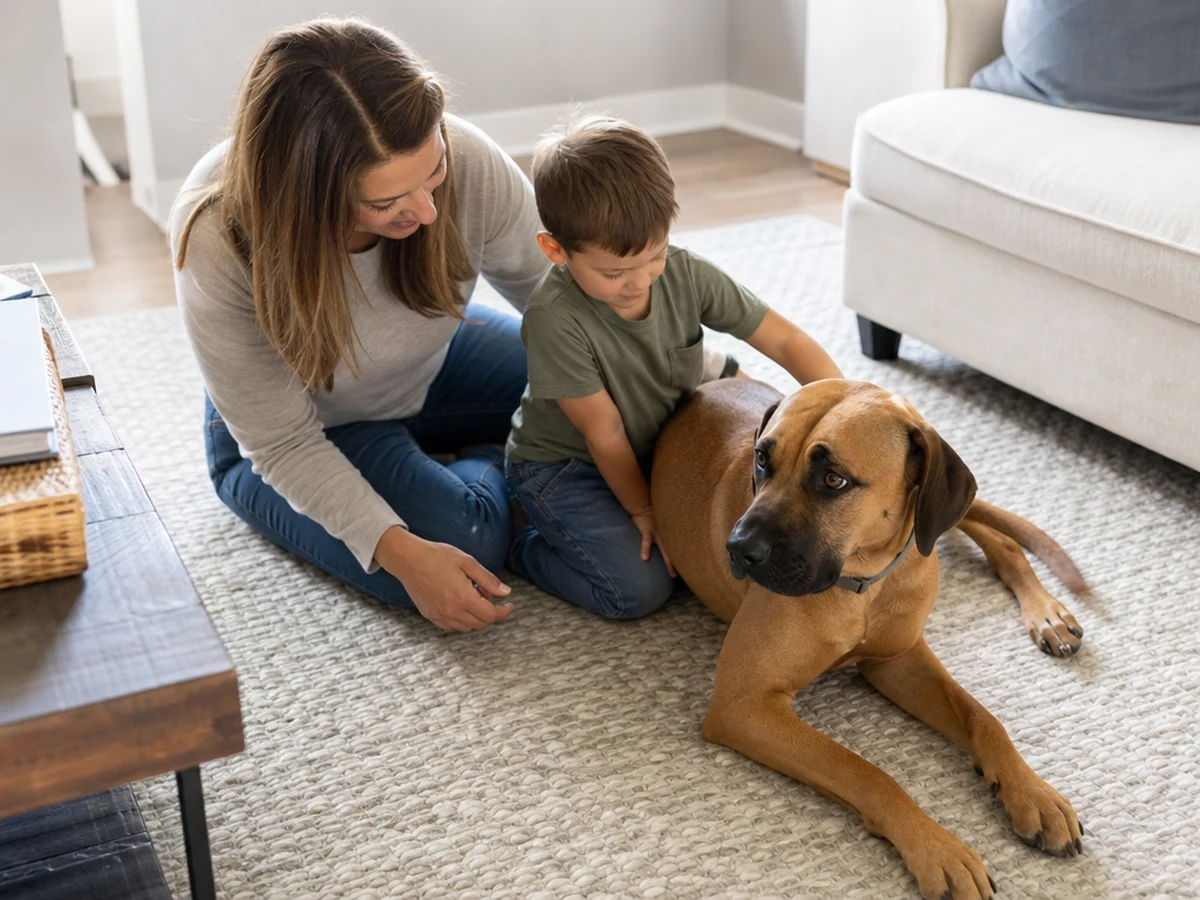
- An adult remains close enough to intervene and ends the interaction before either child or dog becomes frantic.
- Children do not hug, climb on, corner or follow the dog into the resting area.
- Food, chews, sleep and confinement remain private, with a gate providing a visible boundary.
- Games use toys or scattered food rather than hands near the dog's mouth.
- The dog may walk away at any time, and the child learns that departure ends the interaction.
Keep early activities parallel rather than intense. A child can toss food away from their body, read while the dog rests behind a gate, or join an adult on a quiet walk. If mouthing rises, stop the game and create calm space. Consistency matters because Best Friends advises that everyone responds the same way rather than allowing teeth with some people. Rotate quiet roles instead of letting one child become the only source of rewards.
A second child can place food on the floor while the dog remains behind a gate, then walk away. The Cur learns that different young people predict calm structure, while adults retain control of distance and timing.
Socializing Black Mouth Cur Visitors
Prepare the visitor routine before anyone arrives. Set the dog's observation spot away from the entry, place rewards there and ask the guest to cross the threshold without calling to the Cur. The visitor can settle into ordinary conversation while the dog watches from behind a gate or another secure boundary. The breed standard describes strong loyalty and protectiveness, so we do not ask a Cur to welcome every guest instantly.
Reward looking calmly, turning back to the handler and choosing the resting area. Neutral behavior is a successful first visit even if no greeting occurs. If the dog approaches with loose movement, the visitor can remain still and allow a sniff. Food is better tossed to the side than held above the dog's head, because tossing creates room to leave. End while the Cur can still disengage, then record which distance and visitor behavior produced the easiest response.
Repeat the same visitor before seeking variety when possible. Familiarity lets you change one feature, such as the guest standing or walking across the room, without also changing the person. A stable setup makes it easier to see whether the dog is gaining comfort or merely enduring a busier scene. Between visits, rehearse the observation spot with no guest present so it remains a familiar resting choice rather than a place that predicts pressure.
Socializing With Strangers Beyond Home
The neighborhood gives more space than the doorway, so use it to practice observation without contact. Stand far enough from a quiet flow of people that the dog can notice, eat and turn back. Reward the return of attention, then move away before prolonged staring turns into fixation. Change one feature at a time. A person standing still is different from someone walking directly toward you, and a quiet street is different from a delivery area.
The goal is not to expose the dog to every possible person. It is to teach a repeatable response to novelty: notice, check in and continue or create distance. Ask strangers not to pet the dog when the body is stiff, movement slows or the Cur keeps retreating. You do not owe anyone a greeting. If the dog becomes more comfortable after repeated distant views, reduce space gradually while preserving the option to leave. Use a simple exit cue before the dog needs it.
Choose a word the household does not use casually, and pair it with the same smooth movement every time. Say the cue, turn in a gentle arc and reward after the Cur follows. Practice with no stranger nearby first. In a real encounter, the familiar movement gives both dog and handler a rehearsed alternative to stopping for unwanted contact.
Other Dogs Need Selective Socializing
Socializing with dogs does not require crowded, uncontrolled play. A Black Mouth Cur may benefit more from learning to move calmly near a compatible dog than from greeting every dog on the sidewalk. Select partners and settings where both dogs can disengage, and keep the first goal at coexistence.
Build dog contact through distinct layers. Move forward only while both dogs can disengage and return attention:
- Begin with visual observation at enough distance for both dogs to eat and respond to their people.
- Walk in the same direction with space between the dogs, narrowing only when bodies remain loose.
- Allow brief curved approaches rather than a direct rush, then call each dog away for a reward.
- Use off-leash play only in a secure setting with a well-matched partner and attentive adults.
- Interrupt for rest while play is still mutual, and separate immediately when one dog repeatedly tries to leave.
Size and stamina can make an uneven match harder even when intent is playful. Protect smaller, older or less physical dogs from persistent pursuit. Separate food, chews and resting places in a shared home, and practice individual time so neither dog becomes the other's only source of activity.
Black Mouth Cur Socializing in Public
Public socialization asks for calm participation, not popularity. Choose an open edge of a park, a broad walkway or another place where you can leave easily.
Let the Cur watch the environment from outside the busiest flow, rewarding voluntary check-ins and relaxed sniffing. A dog who can pass a person or another dog without contact has learned a valuable social skill. That neutral pass leaves room for the Cur to gather information without making a decision about direct interaction. Add duration only while recovery stays easy. If the Cur remains alert long after a surprise, the environment was too difficult.
Return to a quieter place instead of adding more encounters. Public manners also depend on needs outside socialization. Purposeful exercise, thinking work and recovery make it easier for a dog to process the world, while exhaustion can reduce coping. Balance activity rather than trying to tire the dog into tolerance.
Read Black Mouth Cur Body Language
Now zoom in from the setting to the dog. Read several signals together, because a wagging tail or a single bark cannot explain the whole emotional state. Compare the dog's posture before, during and after the encounter so one unusual movement does not carry the entire interpretation. Watch weight distribution, muscle tension, mouth, eye movement, ability to eat and the speed of recovery after the person or dog passes.
Battersea notes that puppies may mouth more when overstimulated or tired, which makes rising mouthiness a reason to pause rather than press ahead. The same principle applies broadly: when behavior becomes faster, harder or less responsive, reduce social pressure.
| Close Detail | Continue at This Level | Create More Space |
|---|---|---|
| Body | Loose curves and ordinary movement | Frozen posture, repeated retreat or weight shifted away |
| Attention | Looks, then checks back with the handler | Fixed stare or inability to disengage |
| Mouth | Normal breathing and gentle food taking | Sudden closed mouth, frantic food taking or refusal |
| Choice | Approaches and leaves without pressure | Cornered, pursued or unable to reach retreat |
| Recovery | Returns quickly to sniffing or resting | Remains highly alert after the event ends |
A sudden change in sociability, touch tolerance or recovery deserves a veterinary conversation. Keep regular vet visits on the calendar, and involve a veterinarian-referred behavior specialist when reactions involve attempted bites, escalating intensity or situations the household cannot manage safely. Useful socialization does not produce a Black Mouth Cur who greets every child, dog and stranger.
Socializing Means Calm Choice
Black Mouth Cur socialization produces a dog who can notice social information, look to their person, choose contact or distance and recover after the event. That standard respects the breed's documented loyalty without treating protectiveness as destiny. Start at the widest level by fixing household boundaries, then move through visitors, neighborhood space and carefully chosen dog contact. Finish by reading the close details instead of chasing a greeting count.
For related trigger problems, our Black Mouth Cur behavior guide helps separate manageable instinct from a reason to seek help. Calm choice is the thread through every layer. When people protect the dog's retreat, reward check-ins and adjust distance before the body tightens, social experiences become information the Cur can process rather than pressure they must resist.
 Exercise and jobsBlack Mouth Cur: Winding down after work
 BehaviorBlack Mouth Cur Food Guarding: Building Trust Around the Bowl
 BehaviorBuilding Confidence in a Sensitive Black Mouth Cur